An afternoon at Noanet Pond
There is a noticeable change in the sounds of the forest as autumn gives way to late fall. The exuberance of spring, when migrating birds arrive in waves and territorial songs fill the woods, has long since passed. Summer, too, has its familiar soundtrack: the persistent calls of nesting birds, the activity of young fledglings, and the steady exchanges taking place high in the canopy and along the forest edges.
By late November, something different has taken hold. The woods seem quieter, but they are hardly silent. The sounds are more scattered, more fleeting, and often require a little more patience to discover. With the leaves mostly gone, we can see farther into the trees, but the birds themselves seem to have become more elusive. Their voices are no longer the bold declarations of spring. Instead, they are brief calls, soft chips, and occasional bursts of activity as birds keep in contact, search for food, and move through an increasingly open landscape.
I was reminded of this recently while spending some time observing activity on Noanet Pond in Hale Reservation. I was quietly watching the pond when, quite unexpectedly, two golden-crowned kinglets appeared behind me. They were darting about in the nearby branches, moving almost constantly, seemingly unable to stay in one place for more than a moment. Their high-pitched calls filled the immediate surroundings with an unexpected amount of commotion.
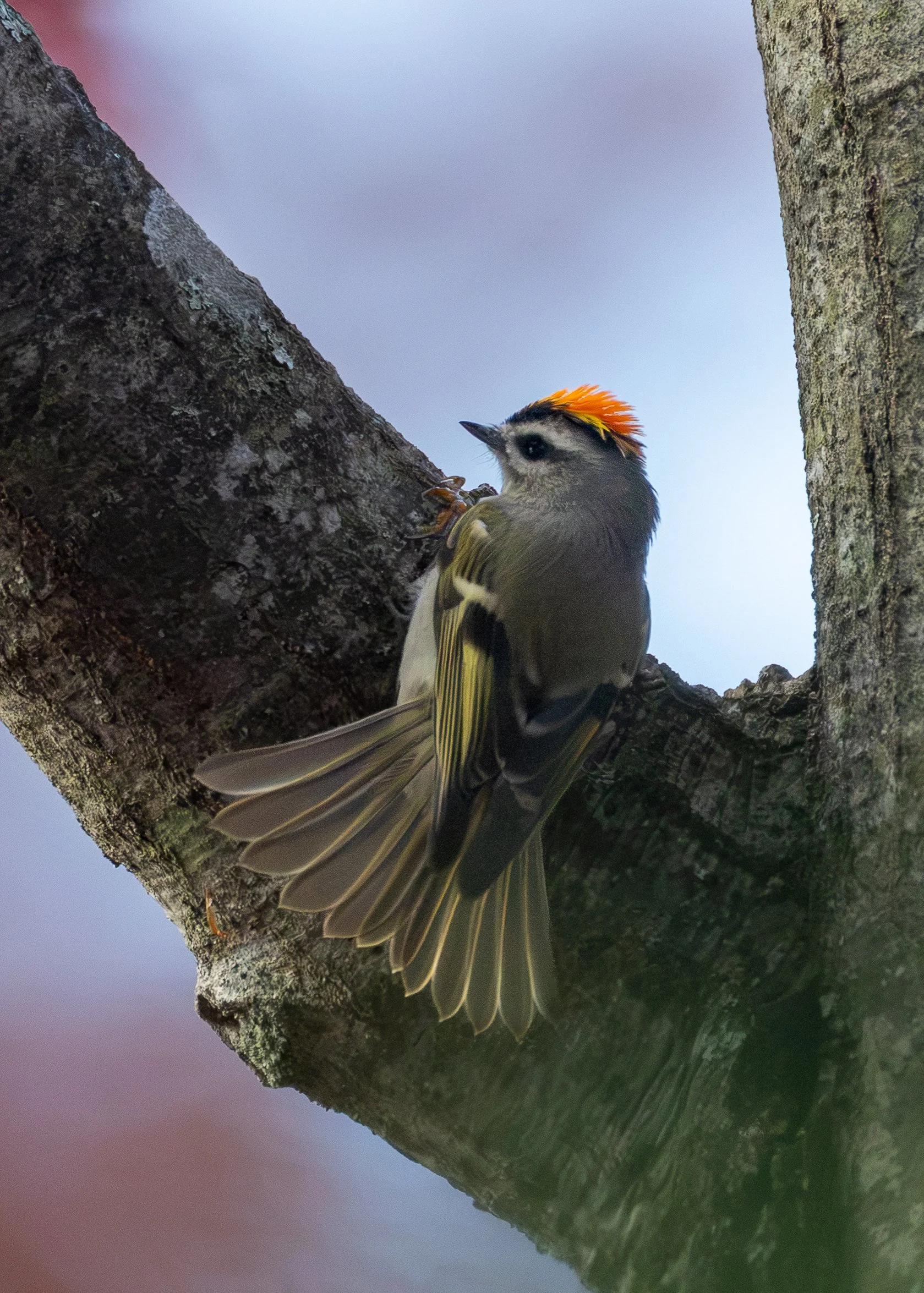
Golden-crowned Kinglet
It was a wonderful little interruption. These tiny birds brought an almost springlike energy to an otherwise subdued late-fall afternoon. Their movements were quick and animated, their calls insistent, and their presence a reminder that the forest is still very much alive, even as the seasons change.
One of them paused long enough for me to capture a photograph. Against the dark, weathered branches, its delicate gray and olive plumage seemed almost understated, until the brilliant golden-orange crown caught the light. Its wings were partially spread, revealing the intricate pattern of its feathers, and its posture suggested that it was ready to take flight at any instant. There was something remarkable about seeing so much energy and character in such a tiny bird. It seemed almost out of place in the stillness of the late-fall woods, yet entirely at home.
Golden-crowned kinglets are particularly interesting in this respect. Among the smallest birds in our region, they remain in New England through the winter, enduring conditions that might seem impossible for such a diminutive creature. As colder weather approaches, they move through the woods in search of tiny insects and other food sources, often joining mixed flocks with chickadees, titmice, and other small woodland birds. Their frequent, high-pitched calls serve as important contact signals, helping them maintain communication as they forage through the branches.
And this is really what makes late-fall birding so interesting. The sounds of the forest have not disappeared; they have changed in character and purpose. The elaborate songs of spring, used largely to attract mates and defend territories, have given way to a more practical vocabulary. There is less singing, but plenty of communication. Short notes, contact calls, and occasional bursts of chatter become the sounds of birds navigating the business of surviving the colder months.
Spring is a season of arrival and announcement. Summer is a season of abundance and activity. Late fall, by contrast, is a season of persistence. The birds that remain have adapted to a different rhythm, and their voices reflect it.
Perhaps the greatest pleasure of late-fall birding is that it asks us to pay closer attention. The grand chorus of spring has faded, and the summer voices have quieted, but the forest has not surrendered its music. Sometimes it comes in the form of two tiny kinglets suddenly appearing behind you, their high-pitched calls breaking the stillness. And sometimes, if you are fortunate, one pauses just long enough for you to appreciate its brilliant crown, delicate feathers, and extraordinary energy.
I had gone to Noanet Pond to observe the water and whatever activity might be taking place there. But two little golden-crowned kinglets reminded me to pay attention to the woods behind me as well. The seasons change, the music changes, but the wonder remains.