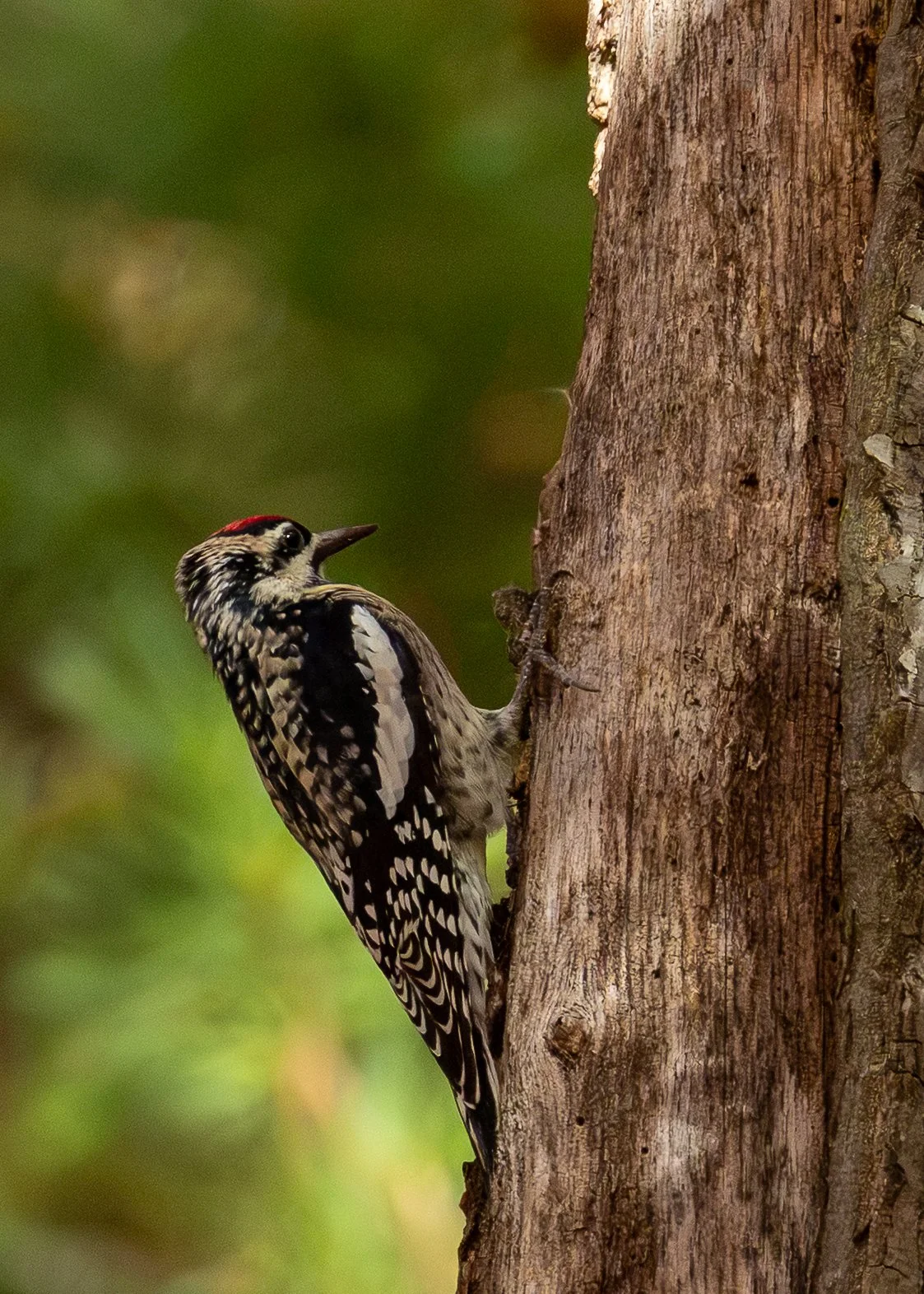
There is something particularly satisfying about encountering a bird that isn't part of the usual cast of characters in a familiar woodland. Recently, while walking through Hale Reservation in Westwood, I came across a Yellow-bellied Sapsucker. It wasn't my first sighting of one, but they are uncommon enough in this part of Massachusetts that the encounter was still a welcome surprise.
Hale has a healthy population of woodpeckers. Downy and Hairy Woodpeckers are familiar residents, and the unmistakable presence of a Pileated Woodpecker, with its powerful bill and distinctive calls, is always an event. These birds are remarkably well adapted to woodland life, using their strong bills to excavate insects from trees, create nesting cavities, and communicate through rhythmic drumming on resonant trunks.
The Yellow-bellied Sapsucker, however, has a somewhat different story. It is one of the more migratory members of the woodpecker family and, unlike our familiar year-round residents, spends much of its life moving between northern breeding grounds and southern wintering areas. Many travel south through New England in the fall, eventually reaching the southeastern United States, Mexico, the Caribbean, and Central America.
Massachusetts sits at an interesting crossroads in this migration. Although sapsuckers breed in parts of the state, particularly in the central and western regions, they are less frequently encountered in southeastern Massachusetts. Their fall passage provides an opportunity to see a bird that otherwise might be absent from our local woodlands for much of the year.
What makes this woodpecker especially interesting is its feeding behavior. Unlike most of our other woodpeckers, which concentrate largely on insects beneath bark and in decaying wood, the sapsucker actually cultivates a food source. It drills neat rows of small holes, known as sapwells, into the trunks of trees, particularly maples and birches. Returning repeatedly to these wells, it feeds on the flowing sap and the insects attracted to it. These sapwells can even become a food source for other birds, including hummingbirds.
Its habitat preferences are interesting as well. During the breeding season, Yellow-bellied Sapsuckers favor younger, regenerating forests and woodland edges, where fast-growing trees provide abundant sap. This is a reminder that healthy woodland ecosystems are not necessarily defined only by old, mature forests. A diversity of tree ages, openings, dead wood, and regenerating growth can support a surprisingly wide range of wildlife.
The photograph captures the bird beautifully against the warm tones of the tree trunk. Its striking black-and-white pattern, bright red crown, and subtle yellow wash on the underside make it a distinctive member of the woodpecker family. It is a handsome bird, and one that can easily be overlooked if you aren't paying attention to the trunks and branches around you.
I find it fascinating that our local woodlands support such different approaches to survival. Some woodpeckers remain here throughout the year, adapting to the changing seasons, while others undertake remarkable migrations in response to food availability and changing conditions. Each occupies its own ecological niche, yet all depend on the health and diversity of the forest.
It is encounters like this that keep familiar places interesting. Even after many visits to Hale Reservation, there is always the possibility of seeing something a little different. Sometimes it is a bird we have seen many times before, and sometimes it is a welcome visitor passing through on its way to somewhere else.